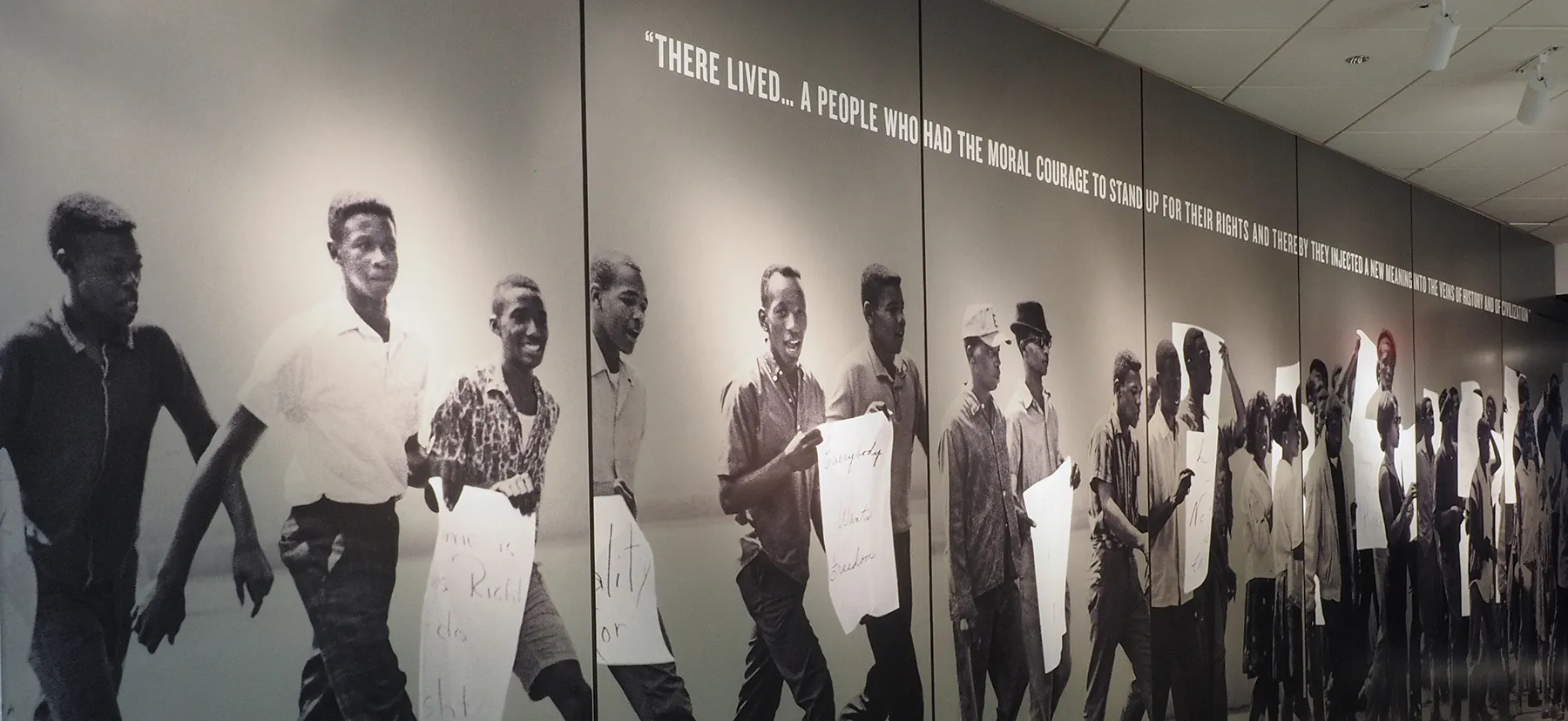
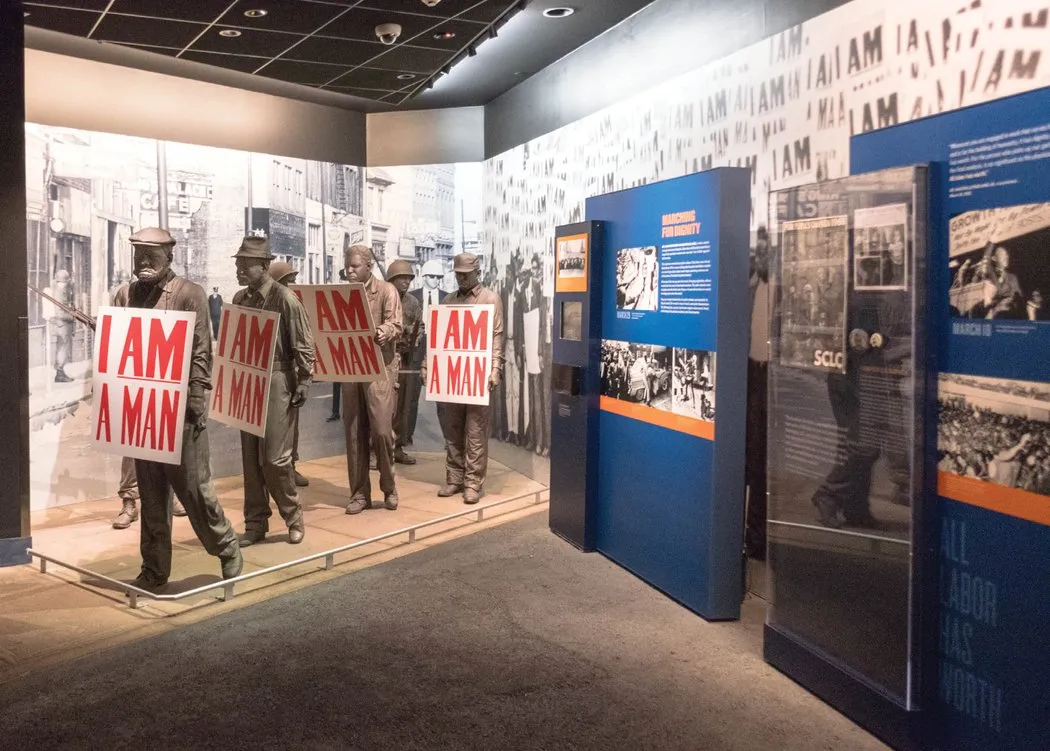
photograph by Gerald Zaffuts
The National Civil Rights Museum stands as a reminder of how far we’ve come — and how far we still need to go.
As seen in Memphis magazine by Tom Jones, June 29, 2026
It was an improbable journey that took the run-down Lorraine Motel from an auction on the Courthouse steps to the National Civil Rights Museum, which next month celebrates 35 years as a Memphis landmark.
The odyssey from the motel sale on December 13, 1982, to the museum dedication on July 4, 1991, was anything but inevitable. Challenge after challenge — financial, political, and cultural — threatened the vision of transforming Memphis’ most tragic site, where Dr. Martin Luther King Jr. was killed, into a site of reflection and reconciliation.
As each threat emerged, A.W. Willis Jr., attorney and the first African American elected to the Tennessee Legislature after Reconstruction, would invariably say, nodding toward the sky: “Don’t worry. Someone bigger than us is in charge of this.”
Some solutions did defy any explanation except divine intervention, and maybe that factors into why the National Civil Rights Museum has become the revered Memphis institution it is today.
Fourteen years after King’s death, the motel was deteriorating in a neighborhood of ramshackle shotgun houses, an abandoned nightclub, and a lounge, with its rooms rented more often for sex work than for business travel.
“I can feel the presence of Dr. King. This is holy ground.” — Nelson Mandela
Ultimately, a determined coalition of Willis, attorney and activist D’Army Bailey, banker Jesse Turner Sr., and media personality Chuck Scruggs stepped forward to champion the idea of a museum. They locked arms and would not be deterred. If any one of them had not been involved, it is hard to imagine that the project would have succeeded.
Willis used his political credibility to win the support of Governor Ned Ray McWherter and to put the museum on the agendas of Memphis Mayor Dick Hackett and Shelby County Mayor Bill Morris. Bailey provided the rhetorical firepower, Turner the financial acumen, and Scruggs offered experience from saving the historically Black Mississippi Delta town of Mound Bayou from bankruptcy.
And yet, the proposal for the museum was a political lightning rod that reflected the broader tensions reshaping Memphis at the time. During the 1980s, Memphis moved from majority white to majority Black, a demographic shift accompanied by white flight as tens of thousands of Memphians moved out of the city and as financing suburban sprawl pushed county government to the brink of insolvency.
State, city, and county elected leaders were bombarded with thousands of political and personal threats if they backed the project and only through strategic political maneuvering did it go forward.
Ben Lawless, retired Smithsonian Institution director who had revolutionized museum displays by introducing theatricality and storytelling, estimated the museum’s cost at $8.8 million. Legislation to fund half of the amount was filed in the General Assembly, and when McWherter, powerful Speaker of the House, endorsed it, the state funding was set in stone.
It was smart politics for McWherter, son of a sharecropper, who, as Democratic candidate for governor, coveted Memphis’ Black vote in his race against Memphis dentist and former Republican governor Winfield Dunn.
Meanwhile, Hackett displayed political savvy of his own. The balance of $4.4 million was to be split between city and county governments. It was widely thought that county commissioners — majority white, Republican, and conservative — would never approve money for the project, so Hackett said he’d support the funding if county government approved it.
Most people thought the project was dead; however, Morris displayed some clever political gamesmanship of his own. He announced solemnly that the county’s $2.2 million was contingent on the museum satisfying a list of rigorous conditions. The county commissioners, assuming the benchmarks were unattainable, approved his plan; however, Morris knew something they didn’t — all of the conditions had already been satisfied during the planning stage.
A political dead end became a breakthrough. Groundbreaking was held January 27, 1989, 10 days after McWherter was sworn in as governor. It was a turning point but also a moment of loss. Willis, so critical to the project, had died six months earlier at 63.
In the years since the groundbreaking, more than two dozen African American and civil rights museums have opened, but the Memphis museum has one deniable advantage — history. It is not just a place where history is interpreted; it is a place for it to be experienced.
Lorraine Motel’s Room 306 where King stayed remains as it was on April 4, 1968. With a recording of Mahalia Jackson singing King’s favorite hymn, Precious Lord, Take My Hand, playing in the background, no other museum can approach the emotional impact that comes from viewing the room and remembering the tragedy that took place as he stepped out to its balcony.
Rihanna said: “I can’t describe the feeling that came over me. You gotta go to experience it for yourself.” Nobel Prize laureate and former South African president Nelson Mandela said: “I can feel the presence of Dr. King. This is holy ground.”
Since the museum opened, the holy ground has more than doubled in size to 60,000 square feet, with renovations and expansions costing more than $72 million. Just last month, it launched a new chapter with its reimagined “Legacy Experience,” which explores the impact of the Civil Rights Movement post-1968. There are technology upgrades and immersive experiences to heighten visitor impact.
Perhaps the most striking thing about the Lorraine Motel’s journey is how easily it could have gone differently. It is no longer just a building in Memphis. It is a reminder of where we’ve been, of what was sacrificed, and how much farther there is to go.
None of the founders are alive today. One thing is certain: in their wildest dreams, they could never have imagined what the National Civil Rights Museum has become on its 35th anniversary.
Although they can’t be there, there’s little question that if Willis were alive, he would be looking skyward once more.