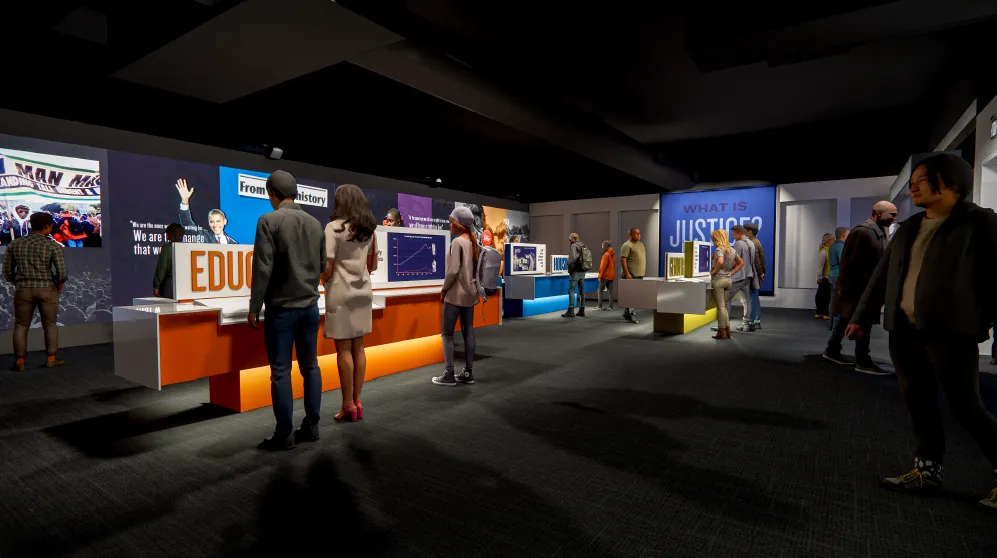
The Civil Rights Movement reshaped the nation. It also revealed the depth of the work still to be done. The Pillars of Justice represent the critical issues that continue to define the pursuit of equality today. Each pillar connects the legacy of past movements to the realities we face now, offering a deeper understanding of how justice is built, challenged, and sustained over time.
Pillars of Justice places visitors at the center of the narrative. Through immersive media, digital installations, and responsive environments, guests can explore pivotal moments of the Civil Rights Movement while drawing direct lines to the challenges and movements of today. These spaces are built to incorporate visitors’ lived experience and encourage deeper reflection through active participation. See how these concepts that Dr. King knew were urgent affect our communities, nation, and the world today.
I. Housing
Housing is more than a place to live. It is a foundation of justice that shapes opportunity, stability, and well being. In this exhibit, you will explore how access to safe and affordable housing has defined who can build wealth, support a family, and feel a sense of belonging. Through interactive displays, data driven insights, and hands on experiences, you will uncover how housing systems have impacted communities across generations and continue to influence daily life today.
You will engage with powerful stories and data that bring these realities into focus. Examine the barriers that have limited home and land ownership, experience the human impact of rising housing costs and neighborhood change, and discover how housing connects to health and environment. This exhibit is your opportunity to see housing is a critical pillar in the ongoing pursuit of equity and justice.
II. Poverty
Economic inequality sits at the center of the fight for justice, shaping who has access to opportunity and who is left behind. In this exhibit, you will explore how the wealth gap, access to credit, and the reality of earning a living wage have impacted individuals and communities across generations. Through interactive displays, data driven insights, and engaging experiences, you will uncover how systems have contributed to cycles of poverty and what it takes to break them.
Learn powerful personal stories that bring these challenges to life. You will examine a variety of contemporary stories that reveal the barriers to fair employment, the fight for better wages, and the daily realities of making ends meet. Discover how communities have organized for change and continue to push for economic justice. This experience invites you to reflect on poverty not just as a condition but as a critical issue at the heart of equity and opportunity.
III. Education
Dr. Martin Luther King Jr. called America’s school system “a system of exclusion.” This exhibit asks whether that has changed. Through artifacts, data, and personal stories, you’ll trace the arc from Brown v. Board of Education to today’s battles over what gets taught and who gets to learn it. You can view Nikole Hannah-Jones’s actual high school essay, the one that sparked The 1619 Project. Flip through the Black ABCs, created by Chicago teachers so Black students could finally see themselves in their own classrooms. Dig into an interactive data dashboard that shows, in plain numbers, how wealth and race still determine the quality of education a child receives. Progress is real. So is resistance. Learn how both emerge as a part of the struggle for equal education today.
IV. Nonviolence
Nonviolence stands as a powerful pillar of justice, shaping movements, communities, and the ongoing fight for dignity and human rights. In this exhibit, you will explore how nonviolence extends beyond protest into everyday life, influencing systems like voting, policing, and incarceration. Through interactive elements, compelling visuals, and data driven storytelling, you will uncover how the principles of nonviolence have been challenged, upheld, and redefined across generations.
As you move through the experience, real stories bring the impact into sharp focus by revealing how individuals and communities navigate a justice system where justice is not always equal, from barriers to voting to the lasting consequences of incarceration. Discover how nonviolence continues to serve as both a strategy and a standard, inviting you to reflect on its role in creating a more just and equitable society.
V. Gender
What does gender have to do with justice? Everything. It shapes what you are paid, whether a doctor believes you when you say you are in pain, whether you make it home safely, and whether anyone in power looks like you. This section of the exhibit does not treat gender as a side issue or a chapter at the end of someone else’s story. It centers the women, particularly Black women, who have been doing the hardest work of the civil rights movement since the beginning while too often being written out of its history. On one side of the interactive table, a data dashboard answers the question the exhibit poses directly: how does gender affect your life? You will find artifacts donated by Tarana Burke, including the original “me too.” t-shirt and the steno notebook where she first wrote a vision for a national campaign to help survivors of sexual violence long before the hashtag existed. See how these and other similar stories reveal the struggle for justice today.